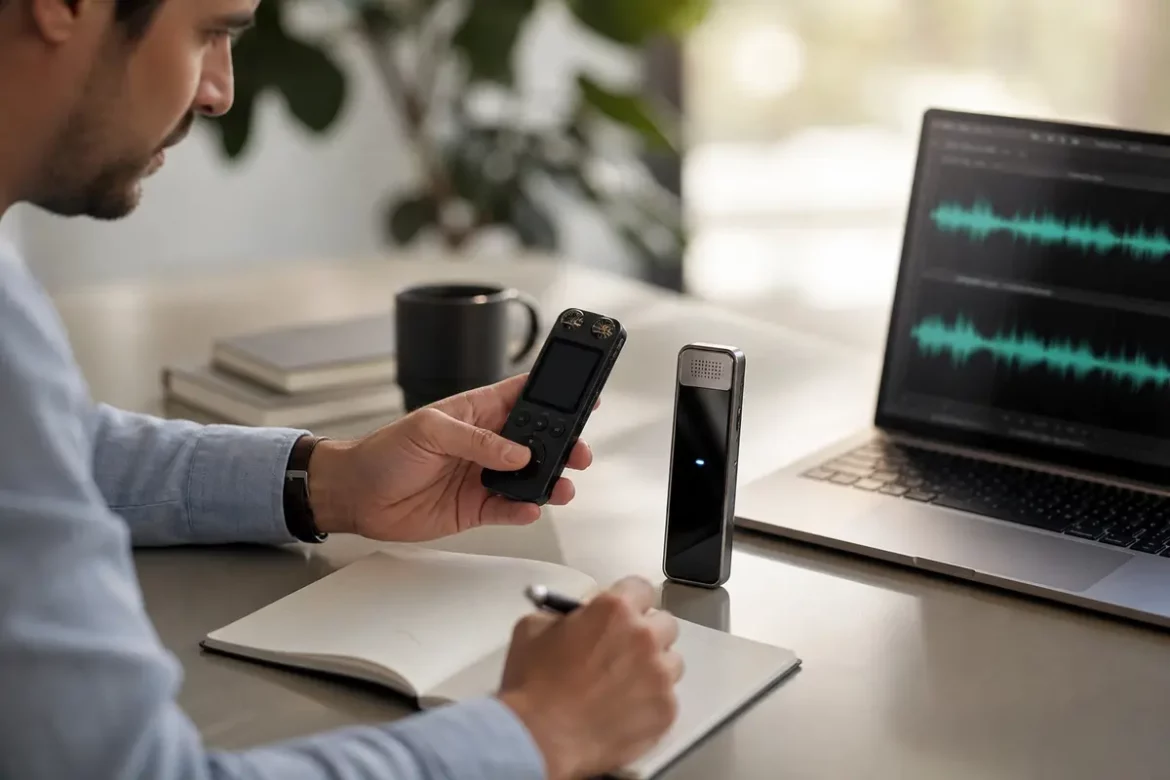
If you need a device for meetings, interviews, lectures, client calls, or field notes, the right choice depends on speed, accuracy, privacy, battery life, and ongoing cost. In this guide, we compare the most important features side by side so you can decide which recorder fits your workflow, budget, and data preferences.
What is a traditional digital voice recorder?
A traditional digital voice recorder is a dedicated device that captures audio and stores it locally on internal memory or removable storage. Its main strengths are simplicity, low one-time cost, and dependable offline recording. Most models focus on microphone quality, battery life, file storage, and easy transfer to a computer.
These recorders are popular with students, journalists, researchers, and professionals who need a straightforward tool without subscriptions or cloud dependence. They usually do one job well: record sound clearly and keep the file on the device until you move it elsewhere.
What is an AI voice recorder?
An AI voice recorder uses built-in software or connected services to process speech intelligently. In addition to saving audio, it may transcribe conversations, summarize long recordings, identify speakers, highlight action items, and make files searchable by keyword. Some models work through onboard software, while others rely on cloud processing after upload.
That extra intelligence can save time in busy workflows. Instead of replaying an hour-long meeting, you can scan the transcript, jump to speaker segments, and review a summary in minutes. For many users, that productivity gain is the main reason to upgrade.
AI voice recorder vs digital voice recorder: key differences
The biggest difference between these devices is not recording quality alone. It is what happens after the recording is captured. A traditional device gives you the raw audio file. An AI device tries to convert that audio into usable information immediately.
Here is the practical tradeoff: digital recorders are simpler, cheaper up front, and usually more private by default. AI voice recorders are faster for review, note-taking, and sharing, but they may introduce subscriptions, cloud processing, and more data handling concerns.
Transcription: manual review versus instant text
Transcription is where AI recorders create the most visible value. A traditional digital recorder does not convert speech to text on its own. You either listen back manually or upload the file to a separate transcription service. That means more steps and more time.
An AI voice recorder can produce transcripts automatically, often within minutes. This helps if you need searchable notes, documented interviews, or meeting records that are easy to scan. However, transcription quality still depends on microphone placement, background noise, accents, speaker overlap, and the AI engine itself.
If you only record occasionally, manual review may be acceptable. If you record often and need the text output, AI transcription can dramatically reduce admin work.
Summaries and action items
Traditional recorders do not summarize audio. You must listen and interpret the content yourself. That works fine for short memos or personal reminders, but it becomes inefficient when recordings are long or repetitive.
AI recorders can summarize meetings, extract key points, and sometimes generate action items or topic headings. This is especially useful for business users who want a quick overview before reading the full transcript. A good summary can reduce a 60-minute session into a few important bullets.
Still, summaries should be treated as helpful tools, not final authority. They can miss nuance, context, or emotional tone, so users should verify important details before sharing them.
Speaker identification
Speaker identification is another major separator in the AI voice recorder vs digital voice recorder comparison. Traditional recorders capture audio from everyone in the room, but they do not label who said what. You must sort that out later by listening carefully.
AI systems may distinguish between speakers and tag turns in the transcript. This is valuable in meetings, interviews, and group discussions. It makes the transcript easier to read and improves searchability. However, speaker identification is not perfect. It can struggle when voices sound similar, when people talk over each other, or when recording conditions are poor.
Cloud processing versus offline operation
Digital recorders typically operate offline by default. They store audio locally and do not need an internet connection to function. That makes them appealing for travel, confidential conversations, and environments where connectivity is unreliable.
AI voice recorders often use cloud processing for transcription and analysis. This approach can improve performance and reduce the processing burden on the device, but it also means recordings may leave the hardware temporarily. Some AI products offer offline modes, but those features may be limited compared with cloud-connected workflows.
If your work involves sensitive topics, legal matters, healthcare information, or private business discussions, offline recording may be an important advantage. If your priority is convenience and searchable output, cloud processing may be worth the tradeoff.
Privacy and ownership of recorded data
Privacy is one of the most important factors in this decision. Traditional digital recorders generally provide a clearer ownership model: you record locally, and the audio file stays on the device until you export it. That makes it easier to control where the data goes.
AI voice recorders can be more complicated. Depending on the platform, recordings may be uploaded to cloud servers for transcription, stored for model improvement, or synced across accounts and devices. That does not automatically make them unsafe, but it does mean you should read the privacy policy carefully.
Before choosing an AI recorder, ask these questions: Who owns the transcript? Is audio stored after processing? Can data be deleted permanently? Is content used for training? Is encryption used in transit and at rest? For professional users, especially those handling confidential information, ownership and deletion controls matter as much as feature lists.
Subscription costs and total cost of ownership
Traditional digital recorders usually have a simple pricing structure: buy the device once, then use it without monthly fees. You may spend extra on batteries, memory cards, or optional software, but the total cost is predictable.
AI voice recorders often come with a more complex cost model. Some include limited transcription credits, while others require a subscription for full access to summaries, speaker labels, search, or cloud storage. Over time, those recurring fees can exceed the price of the hardware itself.
When comparing cost, do not focus only on the purchase price. Consider how often you record, how much transcription you need, and whether the subscription saves enough time to justify the expense. For heavy users, AI features can be worth it. For light users, a traditional recorder may be the smarter investment.
Battery life and portability
Battery life often favors traditional digital recorders. Because they mainly capture audio and store files locally, they tend to use less power and can run for long periods on a single charge or pair of batteries.
AI recorders may consume more battery because they run more processing tasks, manage wireless connections, or sync with cloud services. That does not always mean poor battery life, but it does mean power use can be less predictable, especially when using advanced features.
If you attend all-day conferences, travel frequently, or need a recorder that can stay on for long sessions, battery efficiency deserves close attention. A device that can record for hours without interruption may be more valuable than one with smart features you rarely use.
Audio quality: what actually changes?
Audio quality depends more on microphone design, placement, noise handling, and recording settings than on whether the device is AI-powered. A well-built digital recorder can sound excellent. Likewise, an AI recorder with weak microphones will still capture poor audio.
That said, some AI systems may offer noise reduction, automatic leveling, or enhanced speech optimization. These features can improve usable clarity in busy rooms or outdoor spaces. But they are not a substitute for good recording technique. If the microphone is too far away or the environment is too loud, even advanced processing has limits.
The best way to think about audio quality is this: hardware determines the raw capture, while software may help clean it up afterward. Neither category automatically wins without checking the specific model.
Which type is better for different users?
The right choice depends on your workflow.
Choose a traditional digital recorder if you want:
- Simple, reliable offline recording
- Lower upfront cost
- No subscription fees
- Better default privacy control
- Long battery life for extended sessions
Choose an AI voice recorder if you want:
- Automatic transcription
- Meeting summaries and action items
- Speaker identification
- Searchable text for fast review
- Less manual note-taking
For many buyers, the deciding factor is not recording itself but post-recording productivity. If you spend hours reviewing audio, AI can save significant time. If you mainly want a dependable capture device, traditional is often enough.
Example use case: a programmable recorder for flexible workflows
Some users want a middle ground between a basic recorder and a fully connected AI system. A Wi-Fi enabled and programmable recorder can offer useful automation, scheduled recording, and easier file transfer while still keeping the workflow simple. If that sounds like your need, you may want to explore this Wi-Fi enabled and programmable digital audio recorder as a practical option for flexible recording setups.
This type of device can be a smart fit for users who want advanced convenience without fully committing to cloud-heavy AI tools.
Final verdict: AI voice recorder vs digital voice recorder
In the AI voice recorder vs digital voice recorder debate, there is no universal winner. AI recorders are better if you value speed, automation, and searchable output. Traditional digital recorders are better if you value simplicity, affordability, offline use, and tighter control over your data.
Think of it this way: AI recorders help you process information, while traditional recorders help you capture it. If your work depends on turning speech into usable notes, transcripts, or summaries, AI may be worth the added cost and privacy review. If you mainly need dependable audio capture with minimal complexity, a classic digital recorder remains a strong choice.
The best purchase is the one that matches your recording habits, privacy expectations, and budget today, not just the feature list on the box.
Frequently asked questions
Can an AI voice recorder work without internet?
Some models can record offline, but transcription and summaries may require a connection unless the device has on-device AI features.
Are digital voice recorders more private?
Usually yes, because they store files locally and do not need cloud processing by default.
Do AI voice recorders have better sound quality?
Not necessarily. Sound quality depends more on the microphone and recording conditions than on AI features.
Is transcription included with every AI recorder?
No. Some include limited transcription credits, while others require a subscription for full access.
Who owns the recordings?
That depends on the product terms. With AI tools, always check data ownership, retention, and deletion policies before buying.