That said, understanding voice recorder recording distance helps you choose the right product and set realistic expectations. A small portable recorder may capture a conversation clearly from a few feet away in a quiet room, while a more advanced model can perform better in larger spaces. Outdoors or in busy environments, the usable range drops fast.
What Recording Distance Really Means
Recording distance is the space between the recorder’s microphone and the sound source. In ideal conditions, a recorder can pick up audio from farther away. In practical use, “clearly” means the words are understandable, not just barely audible.
Many people assume that a stronger recorder automatically means a longer range. In reality, clarity is shaped by several factors:
- Microphone sensitivity
- Microphone direction and placement
- Background noise
- Room size and acoustics
- Speaker volume and tone
- Recorder settings such as gain or voice activation
That is why the same device may sound excellent at 6 feet in one room and struggle at 3 feet in another.
Typical Voice Recorder Recording Distance Ranges
While exact performance varies, these general ranges help set expectations for a conventional digital voice recorder:
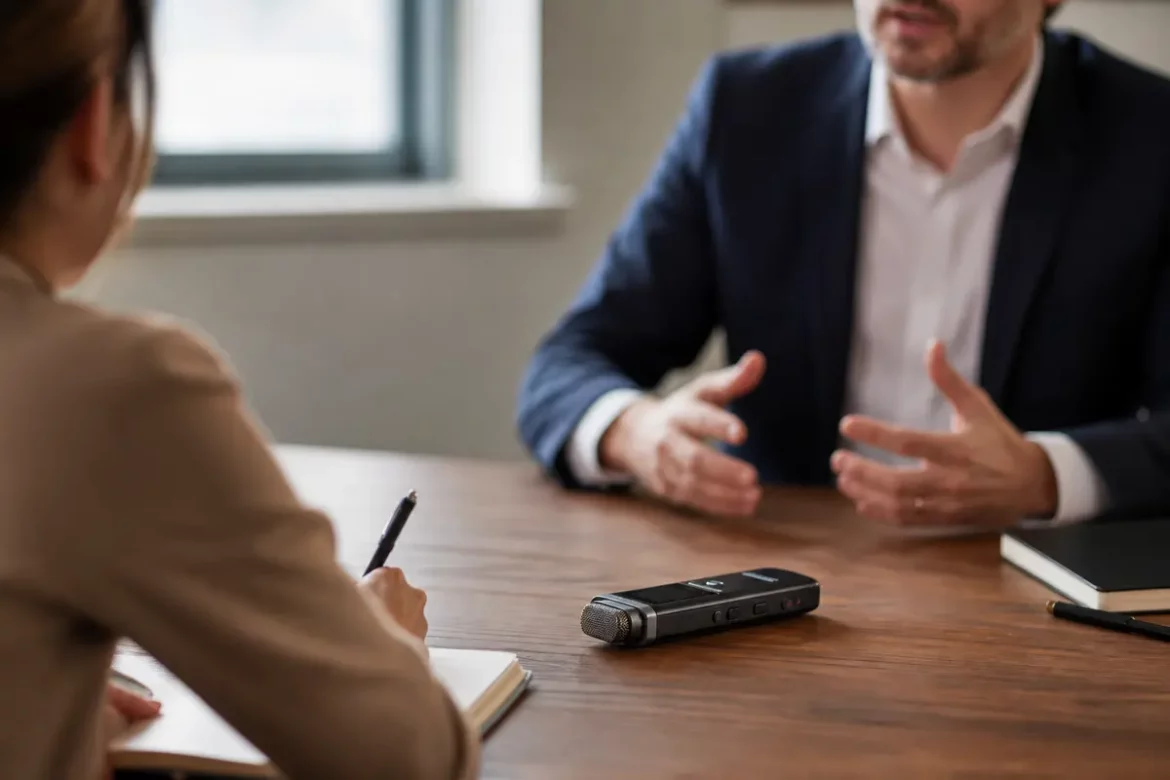
- 1 to 3 feet: Usually very clear for interviews, notes, and one-on-one conversations.
- 3 to 6 feet: Often usable in quiet rooms, though clarity depends on mic quality and speech volume.
- 6 to 10 feet: May still capture understandable speech in controlled conditions, but detail begins to drop.
- Beyond 10 feet: Speech may become inconsistent unless the recorder has strong sensitivity and the room is quiet.
These are not guarantees. They are practical reference points for evaluating voice recorder recording distance during everyday use.
Why Some Recorders Sound Better at a Distance
Not all recorders are built the same. If one model captures speech more clearly from farther away, it usually comes down to microphone design and audio processing.
1. Microphone Sensitivity
Sensitive microphones detect quieter sounds more easily, which can improve pickup at a distance. However, too much sensitivity can also capture more room noise.
2. Built-In Gain Control
Gain boosts the incoming signal. Higher gain can help distant voices sound louder, but excessive gain may introduce hiss or distortion.
3. Directional vs. Omnidirectional Pickup
Some recorders use microphones that focus more on sound in front of the device. Others capture sound from all directions. A directional setup can improve clarity when the speaker is in front of the recorder, while an omnidirectional setup may be better for meetings.
4. Audio Processing Features
Noise reduction, automatic level control, and speech enhancement can improve intelligibility. Still, these tools cannot fully fix poor placement or high background noise.
What Limits Clear Pickup Distance
Even a strong recorder has limits. If you want a realistic answer to voice recorder recording distance, these are the biggest obstacles.
Background Noise
Traffic, fans, air conditioners, conversation, and electronic hum all compete with the speaker’s voice. As ambient noise rises, the recorder must work harder to separate speech from the environment.
Room Acoustics
Hard surfaces create echo, which can blur speech. Soft furnishings like curtains, rugs, and upholstered furniture usually improve clarity.
Speaker Volume
A person speaking softly will be harder to record from a distance than someone speaking clearly and at a normal volume. Voice projection matters more than many buyers expect.
Device Placement
Even a high-quality recorder performs poorly if it is pointed the wrong way, blocked by objects, or placed too far from the speaker.
How to Test Voice Recorder Recording Distance
If you want to know your recorder’s real-world performance, test it instead of guessing. A simple test gives you a much better answer than a product listing alone.
- Place the recorder in a quiet room.
- Record the same short script at 1 foot, 3 feet, 6 feet, and 10 feet.
- Keep your voice at a consistent volume.
- Listen back with headphones, not just phone speakers.
- Note the point where words become difficult to understand.
For a fair comparison, repeat the test in a second environment such as a larger room or a space with some background noise. This shows how sensitive the recorder is to changing conditions.
Choosing the Right Recorder for Your Needs
The best recorder is not always the one that claims the farthest range. Instead, match the device to your actual use case.
- For meetings: Choose a recorder with good room pickup and clear voice enhancement.
- For interviews: Prioritize clarity at close to medium range.
- For lectures: Look for strong speech intelligibility and reliable battery life.
- For casual note-taking: A compact recorder may be enough if you record close to the source.
If you need a broader comparison with other recording technologies, you may also find this related resource useful: How Far Are Audio Surveillance Bugs Competent?. That article focuses on surveillance bugs, while this guide stays centered on conventional digital voice recorders and their typical performance in everyday recording scenarios.
Tips to Improve Clear Pickup at Longer Distances
You can often improve results without buying a new device. Small adjustments make a noticeable difference in voice recorder recording distance.
- Move the recorder closer to the speaker whenever possible.
- Position it at chest or mouth level for better speech capture.
- Reduce background noise before recording.
- Choose a quieter room with less echo.
- Avoid placing the recorder inside bags, drawers, or behind objects.
- Use higher-quality recording settings if storage space allows.
These steps do not change the hardware, but they can dramatically improve clarity and make far-away speech easier to understand.
When “Far Enough” Is Not Good Enough
There is a difference between recording sound and recording it clearly. A voice may be audible from a distance, but that does not mean the recording is useful. If you need accurate notes, transcriptions, or content you can revisit later, prioritize intelligibility over maximum range.
In many real situations, the best results come from a recorder placed closer to the source rather than a more expensive model used at a longer distance. That is the simplest rule to remember when evaluating voice recorder recording distance.
Final Thoughts
A digital voice recorder can often pick up speech clearly within a few feet, and sometimes farther in quiet, controlled conditions. But the real answer depends on the microphone, the room, and how the recorder is positioned. If you test your device properly, you can find its usable range and avoid disappointment.
For most buyers, the best approach is practical: choose a recorder that fits your environment, place it close enough for clear speech, and test it before depending on it for important recordings. That is the most reliable way to measure voice recorder recording distance in the real world.
FAQ
How far can a voice recorder pick up sound clearly?
Most digital voice recorders capture speech clearly from about 1 to 6 feet in normal conditions, though quiet rooms and strong microphones can improve that range.
Does background noise affect recording distance?
Yes. Background noise reduces clarity and shortens the distance at which speech remains easy to understand.
Can a voice recorder record across a large room?
It may capture sound across a large room, but clarity often drops as distance increases. Speech may be audible yet not fully intelligible.
How can I test my recorder’s range?
Record the same short speech sample at different distances in a quiet room, then listen back with headphones to find where clarity begins to fade.